


A morning with Mathi Anna, brass coppersmith of Pudukkottai
Mathi Anna's workshop sits at the end of a lane in Pudukkottai, Tamil Nadu. There is no sign. The neighbours will point you there if you ask. He has been hammering brass on the same anvil for 38 years. His great-grandfather built the anvil in 1923.
When we arrive at 7 a.m., the furnace is already lit. He has been here since 5. "If you start at 9, the brass is too cold to shape," he tells me. "If you start at 5, the metal is sleeping and easy to wake."
I have no idea if that's true scientifically. But I write it down.
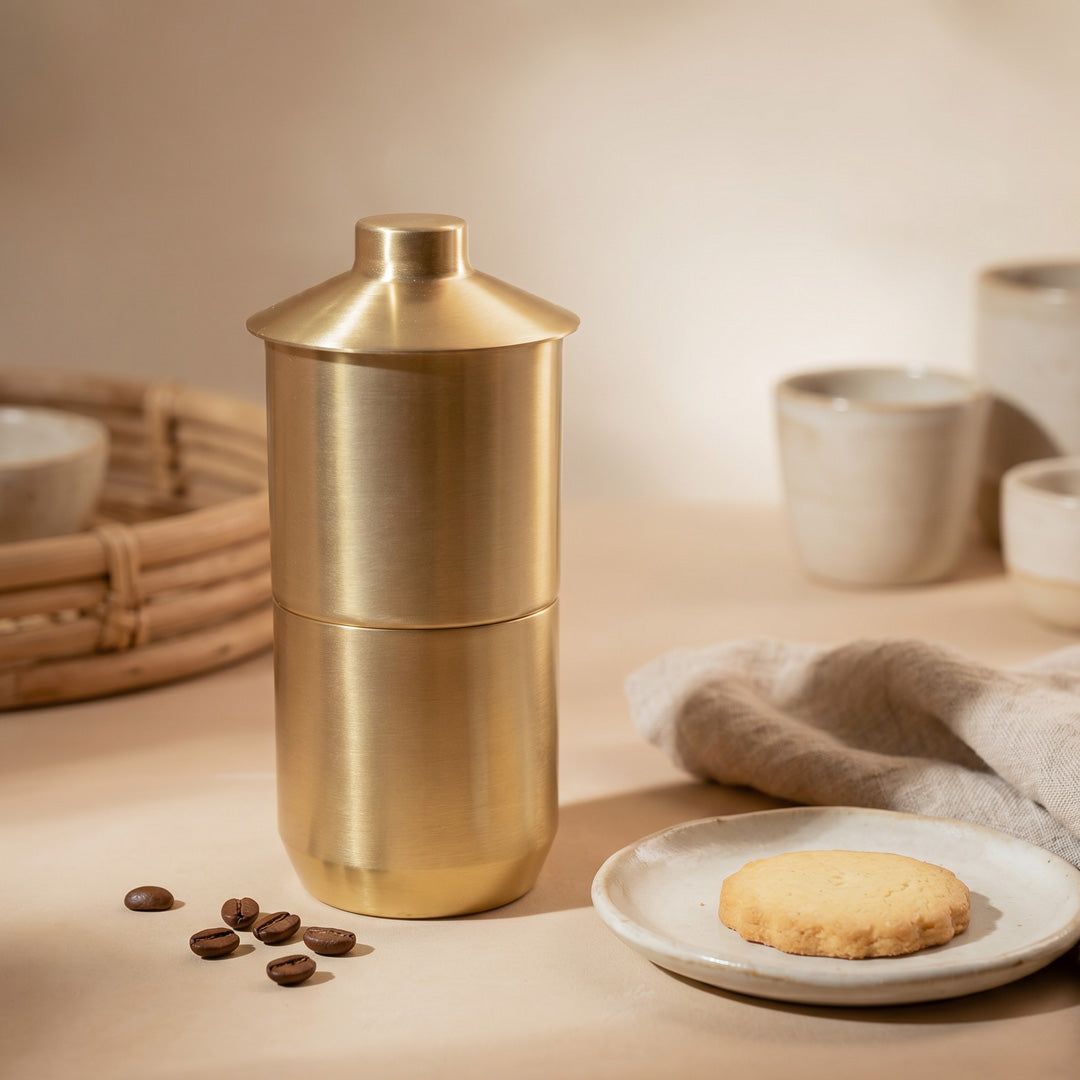
He is making a coffee filter today. A small chamber for grounds, a larger chamber for hot water, a perforated plate, and a lid. Five separate pieces, each hammered from a flat brass sheet over the course of an afternoon. By the end of the day, he will have made three coffee filters. That's it. Three.
I ask him why he doesn't make ten. He laughs.
"Anna, you cannot hurry brass."
The hammer comes down with a precise weight he doesn't think about anymore. The brass sheet slowly cups into a hemisphere. There are fine ridges from each strike — the hammer marks that you see on the finished piece. Machines can replicate these. But Mathi Anna's son, who works in Bangalore now and visits on weekends, says the machine-made ones look "tired". He doesn't elaborate. He just looks at his father's piece, then at a factory-made one we brought as a reference, and shakes his head.
The trade is dying
Mathi Anna's father had seventeen apprentices in the 1960s. He has one. His son is not going to take over the workshop. There's no anger when he tells us this — just an even gaze. "Bangalore is good for him," he says. "Hammering is not for everyone."
I ask what he likes about the work.
He thinks for a minute. Hammer comes down once, twice. The brass dips deeper into the curve.
"The sound," he says finally. "When the metal accepts the strike, the sound is one way. When the metal is fighting you, the sound is another. After many years, you hear it before you feel it. You know the next strike."
We sit with that for a while.
The piece
By 11 a.m. the first coffee filter is taking shape. The base is done. The cylindrical body is half-formed. The perforated plate is sitting on the anvil, awaiting the spike that will punch the holes. Each hole — there are 24 of them — has to be in the right place for the water to drain evenly. If one is too close to another, the decoction stalls in that spot. If one is too close to the rim, the plate loses structural integrity. "I do this by eye," he says. "Twenty years to learn."
We drink coffee. He brought sweet kaapi from home in a brass dabara — the one his wife uses every morning. The decoction is sharp. The milk is full-fat. The sugar is jaggery. I have had filter coffee a thousand times. This one is different.
"Why does this taste better?" I ask.
He shrugs. "It is brass."
What you don't see
The piece he is making today will ship to someone in Delhi or Mumbai or possibly America. The customer will not know Mathi Anna's name. The piece will arrive, wrapped in muslin, with a small card that says "Made in Pudukkottai by hand". The customer will pour hot water into it next Saturday morning. They will wait for the decoction. They will mix it with milk. They will sit on their veranda.
If they pause, even for a second, to feel the weight of the brass in their hand — that's why Mathi Anna stays. That weight is his signature. He cannot tell you in words. But the brass tells you, every morning.