From Molten Metal to Your Table
When you hold a House of Dhatu vessel, you are holding the result of at least seven pairs of hands, each one a specialist in their craft, each one adding precision to what came before. This is not marketing language. It is the literal path a single brass or copper vessel takes from raw ore to finished piece.
Moradabad—the city where every House of Dhatu vessel is made—is not just any brassware hub. It is the brassware hub of India, and has been for over 350 years.
Moradabad: the metal city
In the 17th century, artisans from Delhi were commissioned to craft metal vessels for the Mughal court. When political power shifted, these craftspeople migrated east to a small town in Uttar Pradesh. That town was Moradabad. Over the centuries, entire families and extended communities of metalworkers settled there. By the 19th century, Moradabad had become a center of metal craft so renowned that British colonial administrators began establishing export operations, formalizing the trade.
Today, Moradabad produces over 350 million metal pieces annually. This is not industrial mass production in the modern sense. This is an ecosystem where the knowledge is embedded in the community itself. Fathers teach sons. Uncles teach nephews. The techniques are not written in manuals; they are learned by watching, by doing, by correction and repetition over years.
This is why Moradabad vessels are different. The skill is generational.
Raw material: what "pure brass" actually means
Brass is not an element. It is an alloy—a precise mixture of copper and zinc. True brass is typically 70% copper and 30% zinc. This ratio is crucial. Too much copper and the metal becomes brittle. Too much zinc and it becomes weak and prone to cracking under temperature stress.
When House of Dhatu sources raw brass, we do not accept shipments without verification. Every batch is tested using X-ray fluorescence (XRF) analysis—a non-destructive method that measures elemental composition without damaging the material. We cross-verify with NABL (National Accreditation Board for Testing and Calibration Laboratories) certified testing to ensure the brass meets international standards.
Why does this matter? Because counterfeit alloys exist. Lower-grade brass—sometimes with added lead or other heavy metals to reduce cost—is cheaper to manufacture. A vessel made from adulterated brass is not inert. It leaches harmful substances. It does not have the same thermal properties or working life.
Pure brass, tested and verified, is the only acceptable starting material.
The making process: seven stages, seven specialists
Stage 1: Casting
Raw brass is melted in furnaces at approximately 900 degrees Celsius. It becomes liquid, glowing. The melted brass is poured into molds—some simple, some complex depending on the vessel shape. The molds are stone or metal, designed to cool the brass into an ingot or rough blank that approximates the final shape. This blank is crude, unrefined, but it is the foundation.
The caster must judge temperature, flow, and cooling precisely. Too hot and impurities remain suspended. Too cool and the brass does not fill the mold completely. The caster is the first specialist.
Stage 2: Rough shaping (forging or cutting)
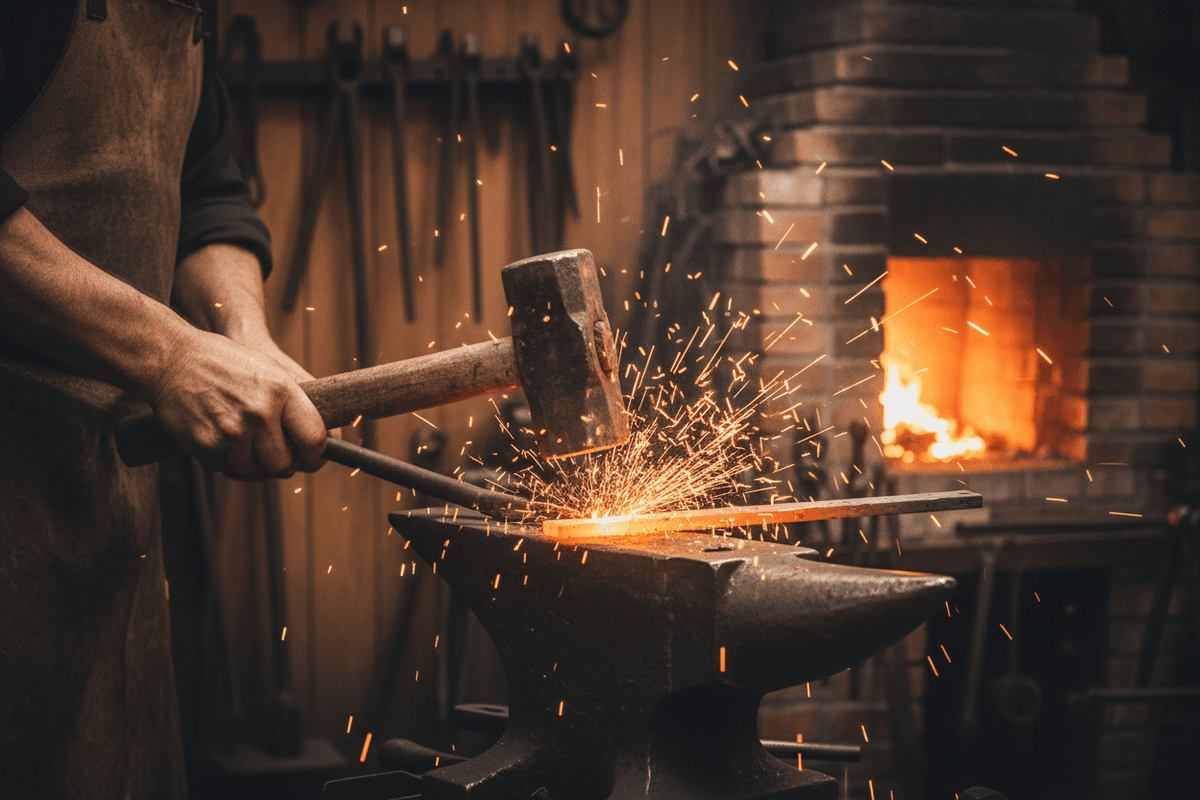
The cooled blank is shaped closer to its final form. For some vessels, this means forging—heating the brass and striking it repeatedly with hammers to compress and shape it. For others, it means cutting away excess material. This stage requires strength and judgment. The craftsperson must know how the metal behaves under heat and pressure.
Stage 3: Lathe work
A skilled lathe operator refines the shape to precise dimensions. The vessel is spun on a lathe—a rotating spindle—and cutting tools remove material with exactness. The inside surface must be smooth and even. The walls must be uniform in thickness. One wrong movement and the vessel is compromised. The lathe operator is responsible for the functional integrity of the piece.
Stage 4: Hand-hammering and forming (if applicable)
Some vessels—particularly traditional Ayurvedic water vessels and kansa bowls—are finished with hand-hammering. This is not decorative. The gentle, rhythmic strikes of a hammer against the metal surface compress the outer layers, making them denser and more durable. It also creates subtle texture and variation that cannot be replicated by machines. Each strike is deliberate. Each blow is calculated for force and placement.
Stage 5: Finishing and edge work
Raw vessel edges are sharp and rough. A finisher smooths and rounds every edge by hand, using files and abrasive tools. This is not quick. It is not glamorous. But a sharp edge on a water vessel is a hazard. A finished edge is a mark of quality.
Stage 6: Polishing
The vessel is polished to a bright, even finish. Traditional methods use powders (chalk, tripoli, or rouge) applied with cloth or wool. The polisher must work every surface evenly—the outside, the inside, the rim, the base. The goal is a uniform shine, no dull spots, no uneven patches. This requires patience and experience.
Stage 7: Final quality check and packing
The finished vessel is inspected by a quality specialist. It is tested for leaks (if applicable), checked for dents or damage, verified for weight and balance. Only vessels that meet standards proceed. The rest are set aside for rework or recycling. This final check ensures that what you receive is complete and correct.
Why machines cannot replace this
Modern manufacturing has optimized efficiency to extraordinary levels. Machines are precise. They are consistent. A CNC lathe will produce identical parts, again and again, without variation.
But there is a reason handcraft persists in Moradabad, even in 2026: subtle variation is not a bug, it is a feature.
Consider a water vessel designed to be held in your hands. The weight distribution should be balanced but not perfectly symmetrical—slight variation prevents the piece from feeling sterile. The rim should be smooth, but infinitesimally textured from hand-finishing, which provides micro-grip without being rough. The thickness of the walls should be responsive to the needs of the specific part—thicker at the base for stability, slightly thinner at the rim for ease of drinking.
A machine makes every piece exactly the same. A craftsperson makes each piece slightly different—better.
Additionally, machines require high capital investment. To justify that investment, manufacturers need high volume and narrow variation. This creates pressure to reduce cost, which often means reducing material quality or thickness. The economic model of industrialization rewards shortcuts. The economic model of handcraft rewards perfection, because the craftsperson's reputation depends on it.
NABL certification: what it verifies
After a House of Dhatu vessel is completed, a sample from the batch is sent to NABL-certified laboratories for final verification. This testing verifies:
- Elemental composition: The brass or copper meets specified purity standards. No undisclosed metals. No contamination.
- Hardness: The material has been properly worked and finished. It is not brittle or weak.
- Physical integrity: The vessel is free from cracks, porosity, or structural flaws that could cause failure during normal use.
- Surface quality: The finish is consistent and appropriate for the intended use.
This certification is not a stamp added for marketing. It is a technical guarantee. If a vessel fails the test, the entire batch is rejected. The craft tradition and the scientific standard work together.
What you are actually holding
When you bring a House of Dhatu vessel into your home, what you are actually holding is the accumulated skill of seven craftspeople, each one a specialist in their stage of the process. You are holding a metallurgical specification verified by an accredited laboratory. You are holding a decision made by your ancestors 5,000 years ago to use these materials, and a decision made yesterday to perfect that design.
You are holding a vessel that was not designed in a spreadsheet. It was not optimized for production speed. It was made by people who made water vessels the day before, and who will make water vessels the day after. This is not nostalgia. This is continuity. This is a craft that has survived empires, colonization, industrialization, and the relentless pressure toward cheaper and faster.
It survived because it is worth the time. The city around it changed. The methods evolved. But the hands remained constant.